Every year on May 28, the world pauses to confront a silent crisis — one that affects millions ofgirls and women not through a lack of ambition or ability, but simply because of their biology.This is Menstrual Hygiene Day, a global movement united behind one mission: Together for a#PeriodFriendlyWorld. In Ghana, that mission could not be more urgent.
The Weight of a Pad
In Ghana, a single packet of sanitary pads can cost between GHS 20 and GHS 40 — a price made heavier by a 20% import tax and a 12.5% VAT that, until recently, classified menstrual products as luxury items (Ghana Revenue Authority). For families already navigating poverty, this is not a small expense. It is an impossible choice.
The consequences ripple far beyond discomfort. According to UNICEF, approximately 95,000Ghanaian girls miss school during menstruation. Research from rural northern Ghana published in BMC Women's Health (2021) found that 40% of schoolgirls reported menstruation-related absenteeism, with some staying away for up to five days in a single month. The reasons they gave are heartbreaking in their ordinariness: menstrual pain (cited by82.2%), fear of staining clothing (70.3%), unavailability of sanitary pads (63.4%), and a lack of private facilities to manage their period at school (60.4%).
Girls who do not receive any allowance for menstrual care products face nearly double the odds of poor menstrual hygiene management compared to those who do (International Journal ofReproductive Medicine, 2020). In rural communities, this disparity is stark: UNICEF reports that 95% of girls in rural Ghanaian communities miss 20% of school because they cannot access sanitary products.
More Than a Hygiene Problem
It is tempting to frame period poverty as a hygiene issue. It is not. It is an equity issue — one woven into the fabric of gender inequality, educational disadvantage, and economic exclusion.
Across sub-Saharan Africa, only 12% of schools provide menstrual materials for free or for purchase, and just 11% have proper bins for menstrual waste in girls' toilets (UNICEF, 2024).Without basic infrastructure — clean water, private changing facilities, waste disposal — even a girl who has a pad faces indignity at school.
Cultural taboos compound the material barriers. In many communities, menstruation is treated with shame and silence. Girls are discouraged from seeking help, discussing their needs, or exploring more affordable options like menstrual cups — sometimes out of unfounded fears rooted in cultural beliefs. This silence is not just uncomfortable; it is dangerous.
The government has taken steps forward. Ghana's 2024 Budget Statement removed VAT on locally produced sanitary pads and introduced import duty waivers for raw materials used in their production. It is a meaningful gesture — but without grassroots, community-level action, policy alone cannot close the gap.
Flowwellness Ghana: Flowing Into the Gaps
This is where we come in.
At Flowwellness Ghana, we believe that no girl should trade her education for her period. We have built our work around a simple but powerful conviction: access to menstrual health is not a luxury — it is a right.
The Buy One, Give One Model
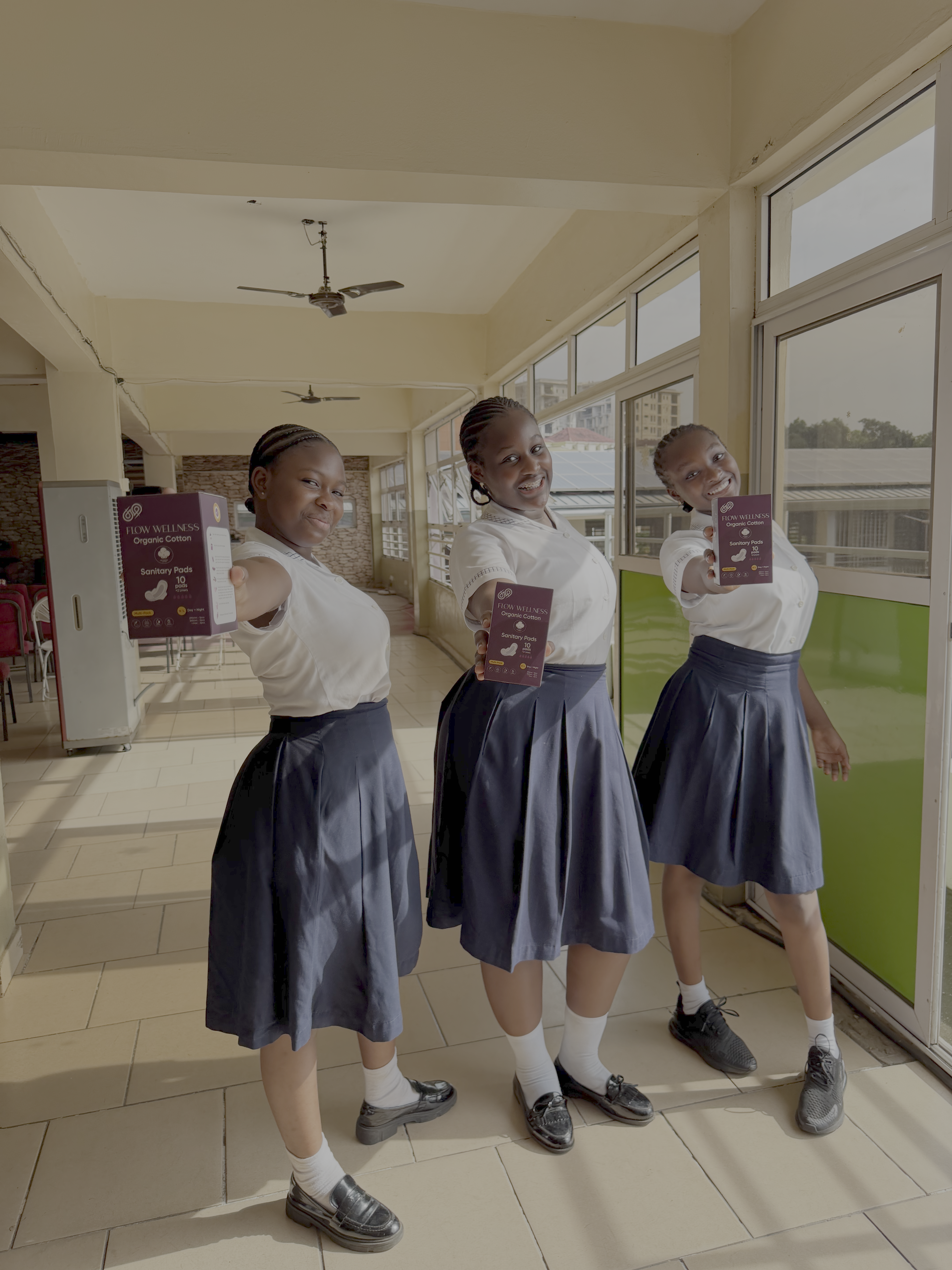
Our Buy One, Give One initiative puts that conviction into practice with every purchase.When you buy a menstrual product from Flowwellness Ghana, a pad goes directly to a girl in an underserved community who cannot afford one. It is a model that turns everyday consumer choices into acts of solidarity — making every customer a part of the solution.
This approach ensures that the choice to support period dignity requires no extra effort, noseparate donation, no guilt. It is simply built into how we operate.
The Flow Project
Our Flow Project goes deeper. Beyond product distribution, it is a community education and empowerment programme designed to break the silence around menstruation in Ghana's schools and communities. Through the Flow Project, we:
- Deliver menstrual health education to adolescent girls and boys in junior and senior high schools, normalising conversations about periods and dismantling harmful taboos
- Train teachers and community health workers to be confident, informed voices on menstrual hygiene
- Distribute sustainable, affordable menstrual products directly to girls in low-income communities
- Advocate for period-friendly school environments — pushing for private facilities,waste disposal, and clean water access in the schools we partner with.
Our work also extends into infrastructure through The Flow Project — an initiative focused on building and renovating school washrooms, installing sanitary pad dispensers, and improving menstrual hygiene facilities in schools and communities. We recognize that solving period poverty requires more than products alone. Girls also need safe spaces, privacy, education, and ongoing support systems.
The Flow Project is built on the understanding that products alone are not enough. Dignity requires knowledge, infrastructure, and a community that does not treat a natural bodily function as something shameful.
The Bigger Picture
Ghana is not alone in this fight. Globally, an estimated 500 million women and girls lack access to adequate menstrual products or sanitation facilities (UN Women). On any given day, more than 300 million women worldwide are menstruating — many of them in silence, without support, without supplies.
The theme of this year's Menstrual Hygiene Day — Together for a #PeriodFriendlyWorld — is acall that resonates deeply with our work. It asks all of us: governments, businesses, communities, and individuals — to act together. Period poverty will not end through any single intervention. It will end when we weave menstrual equity into the fabric of education policy, health systems, economic planning, and cultural norms.
To date Flowwellness has distributed over 10,000 sanitary pads , reached over 5000 girls and has renovated one washroom with a fully equipped sanitary pad dispenser. Our goal is to help create a future where periods never become a barrier to education , confidence , leadership or opportunity.
What You Can Do
The cycle of period poverty can be broken — but it requires all of us.
- Shop with purpose. Every Flowwellness Ghana purchase through our Buy One, GiveOne model sends a product to a girl who needs it.
- Share the Flow Project. Help us reach more schools and communities by amplifying our work. Donate directly to the FlowProject .
- Speak up. Break the taboo in your own circle. Talk about periods without shame.
- Support policy change. Advocate for the full removal of taxes on menstrual products and for WASH infrastructure in every school.
A girl who can manage her period with dignity is a girl who stays in school. A girl who stays in school changes her future — and, in doing so, changes ours.
This Menstrual Hygiene Day, Flowwellness Ghana is committed to making Ghana a place where no girl's future is interrupted by her period. Join us.
About FlowWellness Ghana
FlowWellness Ghana is a Ghanaian-owned menstrual health and wellness company focused on redefining menstrual care through education, access, and innovation. The company provides premium menstrual products while advancing menstrual equity initiatives through education programs, product access, and infrastructure projects across Ghana.